Understanding the symbolism of memorial urn designs
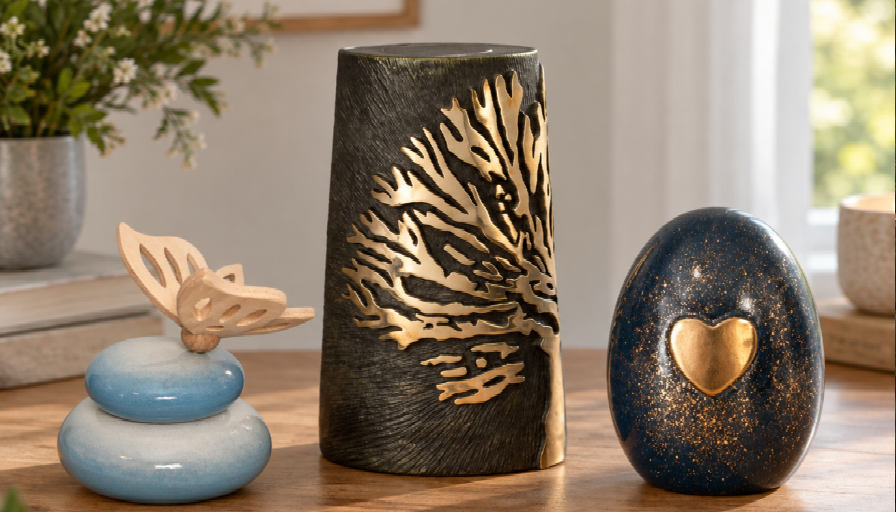
Memorial urn designs often use familiar symbols to express ideas that can be difficult to put into words. A butterfly may represent transformation, a tree may suggest family and continuity, a heart can express love, while birds are frequently associated with freedom, peace or a continuing journey.
These meanings can provide useful guidance when choosing an urn, but they should not be treated as strict rules. Symbols are shaped by culture, religion, art and personal experience. A butterfly that traditionally represents transformation might simply remind one family of a loved one's garden. A woodland scene may represent renewal to one person and a lifetime spent walking outdoors to another.
For that reason, the best starting point is not to ask, "What is this symbol supposed to mean?" Instead, ask, "What does this symbol mean to us?"
If you are comparing memorial urns, consider three things together: the symbolism of the design, its personal connection to the person being remembered, and the practical suitability of the urn itself. Capacity, dimensions, material and intended placement remain just as important as appearance.
Why symbols appear so often on memorial urns
People have used symbolic objects, plants, animals and patterns to represent memory, mortality and continuity for centuries. Memorial design continues this tradition because imagery can communicate meaning without requiring a lengthy inscription.
A symbol can also make an urn feel more personal. A plain vessel may be exactly what some families prefer, while another family may recognise something of the person immediately in an urn decorated with birds, flowers, leaves or a particular landscape.
Symbolism can therefore work on several levels. It may express a broad idea such as love or peace, reflect religious or cultural beliefs, represent a person's interests, or refer to a very specific shared memory.
This last form of symbolism is often the most personal. An oak leaf does not have to be chosen because of its traditional meaning. It might be meaningful because an oak tree stood outside the family home. A rose may be selected because it was someone's favourite flower rather than because of any conventional interpretation attached to it.
What do common memorial urn symbols mean?
Although interpretations vary, several motifs appear regularly in memorial art and urn design. Understanding their common associations can help you narrow your choices without limiting you to a prescribed meaning.
Butterflies: transformation, change and freedom
The butterfly is one of the most recognisable symbols used in memorial design. Its life cycle, moving from caterpillar to chrysalis and finally to a winged form, has long made it an image of transformation and transition.
In a memorial context, butterflies may be associated with change, freedom, hope or the idea that a person's influence continues beyond their physical life. Some people also simply associate butterflies with nature, gardens, summer or a loved one's personality.
A butterfly design can be particularly appropriate when the motif already had significance during the person's life. That personal association is more important than any universal interpretation.
Trees and the Tree of Life: family, roots and continuity
Trees are powerful memorial symbols because they combine several ideas naturally: roots, growth, strength, changing seasons and new branches.
The Tree of Life is especially associated with connection and continuity. Its roots can represent ancestry or a person's foundations, while its branches may suggest children, grandchildren, relationships and the wider influence of a life.
For families choosing a shared or companion memorial, tree imagery can also express the idea that individual lives remain connected as part of a larger family story.
Hearts: love, affection and close relationships
The heart is one of the most direct memorial symbols. It usually represents love, affection and emotional connection, making it particularly relevant for a partner, parent, child or another person with whom there was a close bond.
Heart-shaped urns and keepsake urns can carry an additional meaning because the form itself becomes the symbol rather than merely decorating the surface.
Some families choose several smaller heart keepsakes when ashes are being divided between relatives. In that situation, the symbolism can become particularly fitting: each person keeps a small physical memorial representing a relationship they shared with the person who died.
Birds and doves: freedom, peace and journey
Bird imagery appears across many cultures and artistic traditions. Because birds move between earth and sky, they are often connected with freedom, transition and spiritual ideas.
Doves have a more specific association with peace and are also significant within Christianity. Other birds may carry different personal meanings. A robin, swallow or songbird, for example, might be chosen because someone enjoyed watching birds or because a particular species has become associated with family memories.
When considering a bird design, it is worth distinguishing between traditional symbolism and personal association. Both can be meaningful, but they do not need to be the same.
Flowers: remembrance, beauty and individual meaning
Flowers are common in memorial art, but their meanings vary considerably according to the flower, colour and cultural context.
Roses are often associated with love and remembrance. Lilies have longstanding associations with funerals and can represent purity or peace within certain traditions. Lotus flowers have spiritual significance in several Asian religions and are frequently connected with purity, renewal and spiritual development.
Yet flowers are also among the easiest symbols to personalise. If someone grew lavender, loved sunflowers or always kept roses in the garden, choosing that flower may communicate something much more specific than its traditional symbolism.
Infinity symbols: enduring connection
The infinity symbol, with its continuous looping line, is commonly used to represent something without a defined beginning or end. In memorial design, it can suggest lasting love, an enduring bond or continuing remembrance.
It is sometimes combined with hearts, names or other motifs. When used carefully, this can create a simple contemporary memorial for someone whose family prefers symbolic imagery without overt religious references.
Angels and wings: protection, spirituality and remembrance
Angel imagery is particularly relevant to families whose beliefs or traditions give angels spiritual significance. Wings may similarly represent protection, heaven, freedom or the idea of being carried onward.
These designs can be comforting for some people but may feel inappropriate to others. Religious or spiritual symbolism is most meaningful when it reflects the beliefs of the person being remembered or their family rather than being selected simply because it is commonly associated with memorials.
Nature and landscapes: a life connected to place
Mountains, forests, beaches, leaves and other natural scenes can have less formal symbolism but an exceptionally strong personal connection.
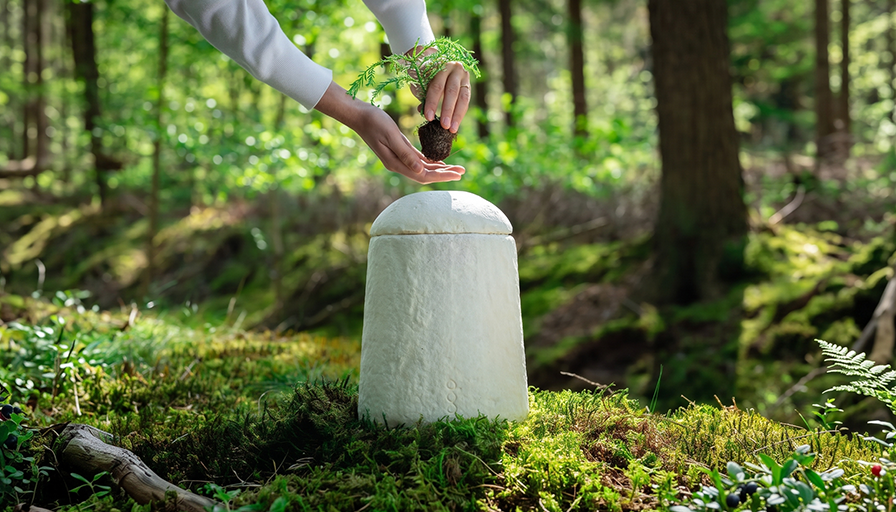
A forest design might suit someone who spent weekends walking in woodland. Waves could recall a lifelong connection with the sea. Mountains might represent adventure, resilience or simply a favourite place.
This type of imagery is useful when you want the urn to recall how someone lived rather than focus specifically on death or mourning.

Religious symbolism and personal beliefs
Religious symbols can communicate faith, spiritual identity and beliefs about death or what follows it. Crosses, angels and doves are familiar within Christian memorial traditions, while other religions and cultures have their own symbols and visual traditions.
It is important not to assume that a symbol carries precisely the same meaning for every person who follows a particular faith. Religious traditions are diverse, and individual beliefs differ.
If religious symbolism matters to your choice, consider whether the design genuinely reflects the person's beliefs. Families who are uncertain may prefer a simpler urn or imagery connected with nature, family or personal interests rather than choosing an explicitly religious motif.
Colour can carry meaning too
Symbolism is not limited to pictures and shapes. Colour can influence how a memorial feels and may carry personal or cultural associations of its own.
White can suggest simplicity, peace or purity. Blue is often perceived as calm and may also recall the sky or sea. Green naturally connects with plants, landscapes and renewal. Gold can add warmth and may be associated with value, light or permanence. Darker bronze, black and earth tones can create a more understated or traditional appearance.
However, colour is especially subjective. A bright colour may be far more appropriate than a conventional neutral shade if it was strongly associated with the person. Their favourite colour, the colours of a garden, a landscape or even a much-loved object can provide a more authentic basis for your decision.
How to choose symbolism that feels personal
If you are unsure which design to choose, start with the person's life rather than browsing symbols at random. A simple decision process can make a large selection feel more manageable.
- Think about places: Was there a garden, coastline, forest, city or landscape that mattered to them?
- Think about interests: Did they love birds, flowers, animals, sailing, walking or another activity that could be represented visually?
- Think about relationships: Would a heart, tree or interconnected design represent family or partnership particularly well?
- Think about beliefs: Is there a religious or spiritual symbol that genuinely reflects their outlook?
- Think about their style: Would they have preferred something traditional, artistic, minimalist, colourful or discreet?
You do not need to find an urn that communicates every aspect of someone's personality. One meaningful connection is usually enough.
Symbolism should not replace practical considerations
An urn can feel completely appropriate visually and still be unsuitable in practical terms. Before making a final decision, check the required capacity, external dimensions, material, closure and intended location.
Capacity is particularly important because an urn must have sufficient internal volume for the ashes it will contain. External dimensions are a separate consideration and become especially important if the urn will be placed inside a columbarium niche, cabinet or another defined space.
Material matters too. An urn intended for a protected indoor location has different requirements from one that will remain outdoors. Do not assume that a design featuring nature, stone or woodland imagery is automatically weather-resistant; suitability depends on the actual material and construction.
If only a small portion of ashes will be kept, a keepsake urn or piece of cremation jewellery may be more appropriate than a full-size urn. Conversely, families intending to keep all the ashes together should confirm that a decorative or sculptural design provides sufficient capacity.
Personalisation can add a second layer of meaning
A symbolic design does not always need further decoration. In some cases, the imagery itself says enough. In others, personalisation can connect a broader symbol more clearly with one individual.
A name and dates are the most familiar options, but depending on the urn, personalisation may also include a short inscription, image, engraved motif or photograph.
Restraint can be useful here. If an urn already has a detailed butterfly, floral scene or sculptural form, extensive text may compete with the design. A simple name or short phrase can sometimes preserve the visual balance more effectively.
Before choosing personalisation, check whether the urn's material and surface are suitable for the technique required. Not every urn can be engraved directly, and available options differ between materials and designs.

Common mistakes when interpreting memorial symbolism
One common mistake is searching for a single "correct" meaning. Symbolism changes between cultures, religions and periods of history. Online lists can provide context, but they cannot determine what an image should mean to your family.
Another is choosing a symbol because it seems appropriate for a memorial even though it had no connection with the person. Conventional memorial imagery can be beautiful, but personal relevance often creates a stronger and more lasting connection.
It is also easy to focus so heavily on meaning that practical details are overlooked. An urn still needs to fulfil its intended purpose, fit its location and provide suitable capacity.
Finally, do not assume a memorial must contain obvious symbolism. A simple ceramic vessel, an understated metal urn or a carefully chosen colour can be just as personal as an elaborate symbolic design. Sometimes the material, shape or craftsmanship is what creates the connection.
Memorial symbolism in the UK and US
Many of the symbols used on memorial urns are familiar in both the UK and the United States, particularly hearts, butterflies, trees, flowers, birds and nature-inspired imagery. Personalisation is also widely used in both countries.
Differences are more likely to arise from individual religious, cultural and family traditions than from nationality alone. The intended use of the ashes can also influence the choice. An urn kept permanently at home may be selected differently from one intended for a columbarium, burial or another memorial arrangement.
When a cemetery, columbarium or other facility will be involved, check its current requirements before purchasing an urn. Size, material or container requirements can vary between individual facilities and locations.
Frequently asked questions about memorial urn symbolism
What does a butterfly on a memorial urn mean?
A butterfly commonly represents transformation, transition, freedom and renewal. Its meaning can also be entirely personal, particularly if butterflies, gardens or nature had significance to the person being remembered.
What does the Tree of Life mean on an urn?
The Tree of Life is often associated with family, roots, growth, connection and continuity. Its roots and branches make it particularly suitable as a symbol of generations and continuing family bonds.
What do birds symbolise on cremation urns?
Birds can represent freedom, peace, transition or a journey. Individual species may carry additional religious, cultural or personal associations. Doves, for example, are strongly associated with peace and also have Christian significance.
Does an urn need to have a symbolic design?
No. A memorial urn can be completely plain or selected primarily for its material, colour, craftsmanship or shape. Symbolism is an option rather than a requirement. A minimalist design can be equally personal when it reflects the person's style.
Can I combine a symbolic urn with engraving?
Often, yes, but this depends on the material, surface and design of the urn. A name, dates or short inscription can complement symbolic imagery, although keeping the personalisation simple may work better with detailed designs. Check the available personalisation options for the specific urn before ordering.
Should I choose an urn based on traditional symbolism or personal meaning?
Personal meaning is usually the more useful guide. Traditional symbolism can help you understand a design, but a motif that relates directly to someone's interests, relationships, beliefs or memories can make the memorial more individual.
Choosing a design that tells part of their story
The symbolism of a memorial urn does not need to explain an entire life. Its purpose can be much simpler: to preserve one meaningful association.
A butterfly might recall a garden. A tree may represent several generations of a family. A heart can quietly express a relationship. A woodland scene might bring back years of shared walks. For another person, an undecorated urn in a favourite colour may feel more appropriate than any recognised memorial symbol.
When comparing designs, begin with that personal connection and then confirm the practical details: capacity, dimensions, material, location and personalisation options. This keeps the decision grounded in both meaning and function.
If you would like to explore further, viewing cremation urns by material, style or design can help you see which forms of symbolism feel relevant. Families wishing to retain only a small amount of ashes can also consider keepsake urns or memorial jewellery where appropriate.
If you feel certain information is missing or you have questions after reading this post, Please feel free to contact us via the contact form.